
Echinacea (purple coneflower)
Echinacea purpurea (L.) Moench · Asteraceae (daisy family) · Part used: Aerial parts and root
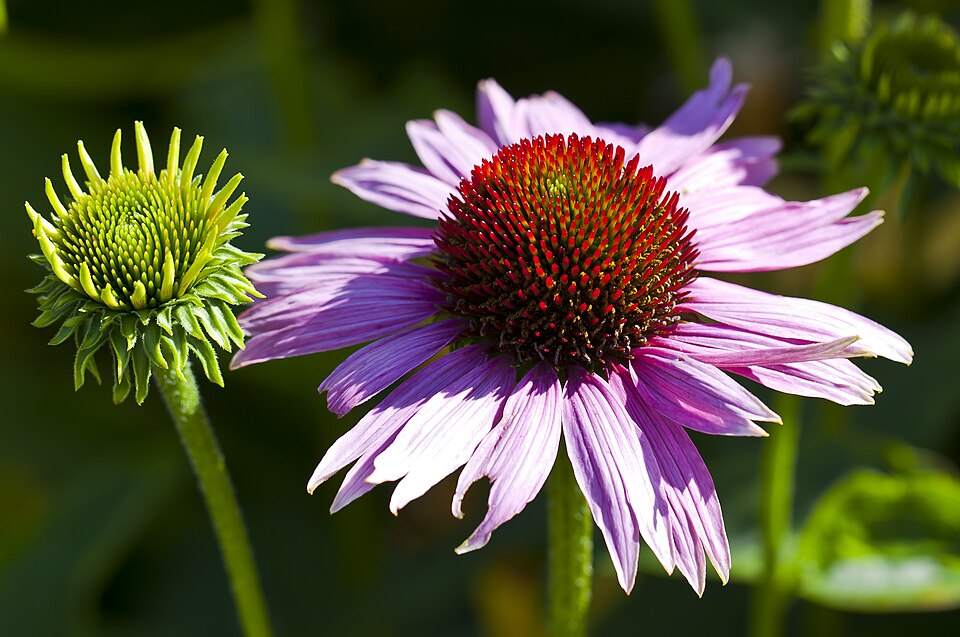

Echinacea contains alkylamides and cichoric acid. Products vary so much that it is hard to say anything general about preventing or treating the common cold.
Main chemical constituents
- Alkylamides (isobutylamides of dodecatetraenoic acid)
- Cichoric acid, caftaric acid and echinacoside (depending on the species)
- Polysaccharides and glycoproteins
Active compounds (layer 3)
Evidence by use
| Use | Evidence level | Notes |
|---|---|---|
| Preventing the common cold | Preliminary evidence | A 2014 Cochrane review found that products differed widely and that the evidence was not convincing. |
| Shortening a cold | Preliminary evidence | Results are inconsistent. |
Safety and precautions
- It is usually well tolerated in the short term, but it can cause a rash or indigestion.
- People who are allergic to the daisy family (Asteraceae) may react to it.
- It may interact with drugs broken down by CYP3A4, so ask a pharmacist if you take prescription medicines.
Related articles
References
- Karsch-Völk M, et al. Echinacea for preventing and treating the common cold. Cochrane Database Syst Rev. 2014;(2):CD000530.