
Lion's mane mushroom
Hericium erinaceus (Bull.) Pers. · Hericiaceae (tooth fungus family) · Part used: Fruiting body; cultivated mycelium
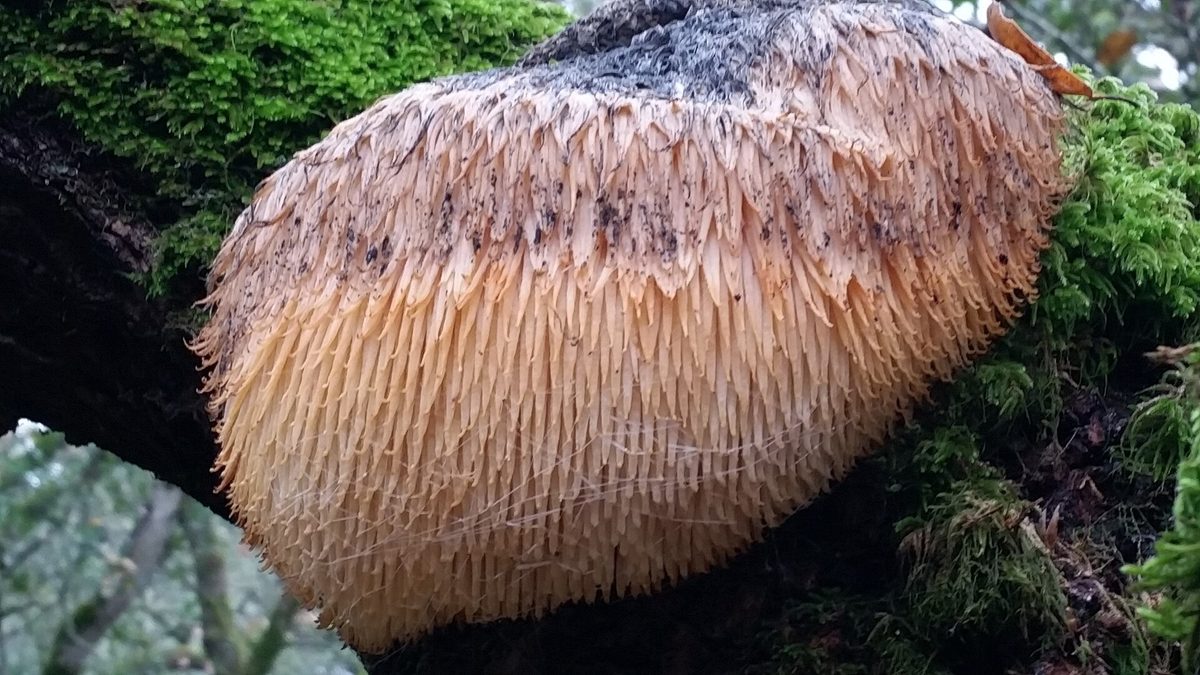

Nấm đầu khỉ is an edible mushroom with a shaggy white fruiting body. Cell studies of its hericenones and erinacines suggest effects on nerve growth. In people, the trials are very small: one in mild cognitive impairment and a pilot in mild Alzheimer's disease.
Main chemical constituents
- Hericenones, aromatic compounds with a fatty-acid chain, from the fruiting body
- Erinacines, cyathane diterpenoids, mainly from the mycelium
- Polysaccharides (β-glucans) and ergosterol-type sterols
- A nutritionally rich fruiting body: protein, fibre, vitamins and minerals
Active compounds (layer 3)
Evidence by use
| Use | Evidence level | Notes |
|---|---|---|
| Mild cognitive impairment | Preliminary evidence | In a double-blind trial in 30 Japanese adults aged 50 to 80, 3 g a day of dried fruiting body for 16 weeks raised cognitive scores compared with placebo from week 8; the scores fell again four weeks after stopping. |
| Mild Alzheimer's disease (erinacine A-enriched mycelium) | Preliminary evidence | A pilot double-blind trial over 49 weeks reported higher cognitive and daily-living scores than placebo. It was small, and four people dropped out because of abdominal discomfort, nausea or rash. |
| Cognition and stress in healthy young adults | Preliminary evidence | A pilot trial in 41 adults found a quicker Stroop task 60 minutes after 1.8 g, and a trend to lower stress after 28 days. Null and limited negative findings were also seen. |
What the evidence applies to
Three different products: dried fruiting-body powder (3 g a day in the cognitive-impairment trial, 1.8 g in healthy adults) and erinacine A-enriched mycelium capsules in the Alzheimer's pilot. The evidence does not transfer between them.
What would change this grade
Up: a larger pre-registered trial of one of these products in mild cognitive impairment. Down: null results from adequately powered trials.
Last reviewed: 9 October 2026
Safety and precautions
- As a food mushroom it is widely eaten and was well tolerated in the small trials; laboratory tests in the 2009 trial showed no adverse effect.
- Mild abdominal discomfort, nausea and skin rash were reported in the 49-week trial. People allergic to mushrooms should avoid it.
- Evidence is for dried fruiting body or mycelium extracts; products differ in hericenone and erinacine content.
References
- Mori K, Inatomi S, Ouchi K, et al. Improving effects of the mushroom Yamabushitake (Hericium erinaceus) on mild cognitive impairment: a double-blind placebo-controlled clinical trial. Phytotherapy research : PTR. 2009;23(3):367-372. doi:10.1002/ptr.2634. PMID: 18844328
- Friedman M. Chemistry, Nutrition, and Health-Promoting Properties of Hericium erinaceus (Lion's Mane) Mushroom Fruiting Bodies and Mycelia and Their Bioactive Compounds. Journal of agricultural and food chemistry. 2015;63(32):7108-7123. doi:10.1021/acs.jafc.5b02914. PMID: 26244378
- Docherty S, Doughty FL, Smith EF. The Acute and Chronic Effects of Lion's Mane Mushroom Supplementation on Cognitive Function, Stress and Mood in Young Adults: A Double-Blind, Parallel Groups, Pilot Study. Nutrients. 2023;15(22):4842. doi:10.3390/nu15224842. PMID: 38004235
- Li IC, Chang HH, Lin CH, et al. Prevention of Early Alzheimer's Disease by Erinacine A-Enriched Hericium erinaceus Mycelia Pilot Double-Blind Placebo-Controlled Study. Frontiers in aging neuroscience. 2020;12:155. doi:10.3389/fnagi.2020.00155. PMID: 32581767